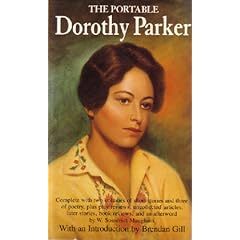
Sorry for the wait on posting. I just wanted to finish a section of poetry before I started. Anyways, through reading Dorothy Parker's poems, I've been starting to think...what exactly is "wit"? According to my dictionary, "wit" is defined as "the keen perception and cleverly apt expression of those connections between ideas that awaken amusement and pleasure." That was a start. The first literary work I have been reading is called, "The Portable Dorothy Parker". It contains all of her works, including her short stories, poems, plays, and book reviews. I've decided to tackle the poetry first since I find that post difficult. Interestingly enough, the chapter itself is called, "Enough Rope" which I thought was already witty. The connotation of the word, "rope" makes me think of a hanging or a suicide. Having "enough" of it can mean it can be carried out. Why would Parker use this to begin her poetry component? What is this going to tell me about her views? I already contemplated about that before I read her poetry and her purpose with which she wrote the poems.
The False Friends
by Dorothy Parker
They laid their hands upon my head,
They stroked my cheek and brow;
And time could heal a hurt, they said,
And time could dim a vow.
And they were pitiful and mild
Who whispered to me then,
"The heart that breaks in April, child,
Will mend in May again."
Oh, many a mended heart they knew.
So old they were, and wise.
And little did they have to do
To come to me with lies!
Who flings me silly talk of May
Shall meet a bitter soul;
For June was nearly spent away
Before my heart was whole.
The purpose of this poem is to express Parker's views about typical "friends" and companions in response to the speaker's emotional turmoil. What really struck me about this poem was her choice of diction. She uses standard, monosyllabic words that are curt and effective because of their connotation. For example, the word, "pitiful" is used to express the way her friends act towards her when she has gone through a drastic situation in which a man has broken her heart. She chooses the word in order to mock the typical response to how others react when someone's heart is broken. She juxtaposes this word with "mild" in order to show that the friends are being "amiably gentle or temperate in feeling or behavior toward others" despite the fact that their reaction is cliche and not genuine. She also mocks the fact that because her friends are of old age, they think they are knowledgeable concerning this topic. She uses the word, "lies" to emphasize the fact that she knows her friends are disingenuous and cliched.
Oh, many a mended heart they knew.
So old they were, and wise.
And little did they have to do
To come to me with lies!
Who flings me silly talk of May
Shall meet a bitter soul;
For June was nearly spent away
Before my heart was whole.
The purpose of this poem is to express Parker's views about typical "friends" and companions in response to the speaker's emotional turmoil. What really struck me about this poem was her choice of diction. She uses standard, monosyllabic words that are curt and effective because of their connotation. For example, the word, "pitiful" is used to express the way her friends act towards her when she has gone through a drastic situation in which a man has broken her heart. She chooses the word in order to mock the typical response to how others react when someone's heart is broken. She juxtaposes this word with "mild" in order to show that the friends are being "amiably gentle or temperate in feeling or behavior toward others" despite the fact that their reaction is cliche and not genuine. She also mocks the fact that because her friends are of old age, they think they are knowledgeable concerning this topic. She uses the word, "lies" to emphasize the fact that she knows her friends are disingenuous and cliched.

2 comments:
hey Dina, this looks like a very interesting topic! I always thought wit to be the definition you provided, but its intriguing that I could discover a whole work of literature focusing just on it. I like your analogy of "enough rope", how you associated rope with suicide, and then integrated "enough" of it to accomplish the hanging. Yet, i can see your connection, i agree too and I'm sure it's quite witty how she uses it in her chapter, if i knew what she wrote. But also judging from th e cover, this looks like its pretty old, definitely not a modern image, thus could the connotations of wit be different in our society today? Correct me if I'm wrong. Could puns be wits too? Like the poem, was April, May and June names of her "so called friends" and the actual months itself? I'm just curious =)
wow, actually, I never really thought of that! I'll focus more on that this week and see if I can find more examples of that! Thanks for the idea =]
And I'm not sure if wit is used differently during her time..she doesn't really defines, but uses it. But we'll see.
Post a Comment